Head-Down 304 — Fly base on a head-down big-way
version 2026-09-27
Prerequisites
What you’re learning
You’ll learn to fly a base slot on a head-down big-way: launch the base, steer it onto heading, and hold heading and fall rate while the floats and divers dock on you. Head-Down 301 comes first, because it teaches the exit slots and docking in small groups.
In Australia, head-down jumps of more than 3 people need a Freefly Crest (Head-Down), and jumps of more than 10 also need a Star Crest.
The base slots
The slots, grips and climb-out are in Head-Down 301. On a big-way every approach is flown off the base. Left and right assume a door on the left.
- Inside Centre keys the exit and holds the formation’s heading and fall rate.
- Front Float anchors the base. Put the heaviest jumper here: a heavy flyer pulls the base down out the door, and a light one lets it over-rotate.
- Outside Centre steers the base onto heading, on level with Inside Centre.
- Tail rotates out with the group, head low, arms strong and legs relaxed. Keep your handles clear of the door frame, because a handle snagged there can open a container in the door.
Walk the launch in the mock-up in the briefed grip order, then dirt-dive the whole jump. On the key, set your grips and heading through the hill, clear of the aircraft.
Breakoff:
- With others: break grips and turn 180° from the formation before you track your radial, or another jumper’s line can cut across yours. Clear the air behind you, transition to your back and clear above, then to belly and keep clearing. Slow to a belly fall rate and deploy at the base wave’s altitude, ready on the rear risers, then fly the briefed canopy separation and landing order.
More in Improving the breakoff. AXIS covers the head-down breakoff, with a video.
Steering onto jump run
Divers approach down the flight line behind Inside Centre, floats from behind Outside Centre. Those lanes only open with the base facing jump run.
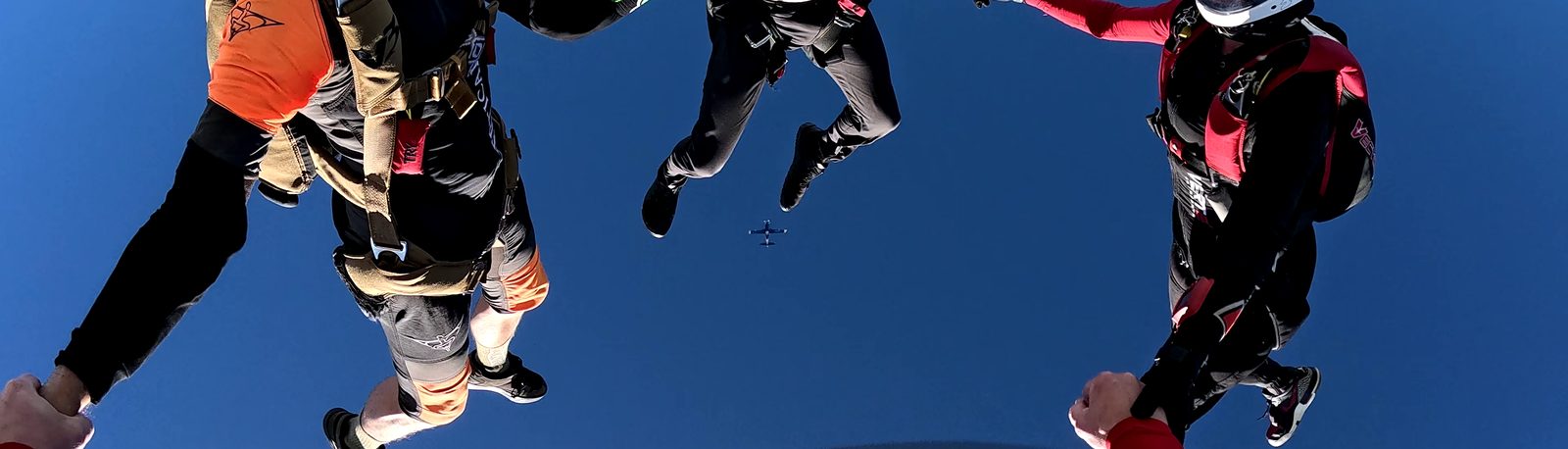
As Outside Centre, watch the aircraft fly away down jump run and steer until it sits between Inside Centre’s legs.
- With no rotation off the exit, about 90° of rotation to the right shoulder sets heading.
- If the base rotates slowly to the right on its own, stop it on heading with anti-rotation to the left.
- A messy exit usually rotates fast onto the base’s left shoulders. Expect it, and counter-rotate firmly to the right.
Holding the base
On heading, hold heading and fall rate and take docks without being driven down. Present your arms for the stingers and hold the head-level stepping the organiser briefed.
When a knock hits the base, tuck your chin, close your legs and increase your fall rate. Spread legs pop you up into the divers. More in Slot discipline.
Common mistakes
| What happens | Usual causes | Check |
|---|---|---|
| The base over-rotates on exit | A light flyer on Front Float | The heaviest jumper on Front Float |
| The base finishes off heading | Outside Centre watching the formation, or late on a messy exit’s fast rotation | Watch the aircraft, and expect the rotation to the left |
| The base moves off its slot | Chasing a stinger who fell off | Hold the slot and let the stinger come back in |
If you become unstable, hold your fall rate, recover to back-fly clear of the traffic, and rejoin once you’re stable and on level. More on corking.
Staying safe
Before the jump:
- Know your breakoff wave, its altitude, your radial and your deployment altitude, and check your wave leaves at least 1,000 ft between breakoff and deployment.
- Set your audible to the base wave, and wear two, because one can fail unnoticed. The rest of the gear check is in Freefly 100.
In the air:
- Break off at the base wave’s altitude, with the formation complete or not. Most of the separation comes from the staged wave altitudes.
When you’ve got it
Debrief the base’s heading, fall rate and breakoff on video with the organiser, and log your slot, wave and one fix.
You’ve finished Head-Down 304 when you fly two jumps in a row that meet everything on the coach’s checklist below.
Next
Head-Down 305: Fly intermediate vertical formation skydiving (VFS). Or, once you have flown Head-Down 302, 303 and 304, Head-Down 401: Organise head-down big-ways.
For coaches: the checklist, assessment conditions and coaching priorities
The checklist
1. Plan the jump
- 1.1
- State own base slot, grips and heading reference from the organiser's brief.
- 1.2
- Confirm the exit stack order and the base's launch count.
- 1.3
- State the briefed breakoff, own wave, altitude, radial and deployment altitude, confirming own wave banks at least 1,000 ft between breakoff and deployment.
- 1.4
- Confirm own currency and qualifications against the organiser's entry criteria and the local entry requirements.
2. Prepare
- 2.1
- Complete a freefly-specific gear check (handles, hand-deploy pouch, riser covers, closing loop, helmet, audible set to the base wave and functioning).
- 2.2
- Walk the base launch in the mock-up in the briefed grip order.
- 2.3
- Dirt-dive the launch, heading hold, dock absorption and breakoff sequence at least twice.
3. Perform
- 3.1
- Launch the base on the briefed count, setting grips and heading through the hill without contacting the aircraft.
- 3.2
- Fly own base slot's exit role, Front Float anchoring down without over-rotation; Outside Centre steering the aircraft's path to finish between Inside Centre's legs and managing the rotation case; Tail rotating out with the group, head low, legs relaxed.
- 3.3
- Hold heading and levels with the leader, arresting base rotation with anti-rotation toward the correct shoulder.
- 3.4
- Hold fall rate steady as the reference for every approaching flyer, absorbing docks without being driven down.
- 3.5
- Take a knock without corking, tuck the chin, close the legs and go faster; do not spread the legs.
- 3.6
- Present arms for the incoming stingers and hold the head-level stepping the organiser briefed.
- 3.7
- Hold the base's slot rather than chasing a lost stinger, a base that moves defeats every sight picture on the load.
4. Complete
- 4.1
- Initiate breakoff at the briefed base-wave altitude (within −0/+300 ft), regardless of formation completeness.
- 4.2
- Break grips, turn 180° from the formation, clear airspace, peel onto the back clearing above, rotate to belly and keep clearing, decelerate, then deploy, turning 180° before tracking, or risk being cut across by another jumper's line.
- 4.3
- Track the assigned radial, shading away from jump run if briefed.
- 4.4
- Deploy at the base wave's briefed altitude after checking airspace, ready on the rear risers in a crowded column; barrel roll only if smooth.
- 4.5
- Fly the briefed canopy separation and landing order.
5. Review
- 5.1
- Debrief the base's heading, fall rate and breakoff against video.
- 5.2
- Contribute observations of exit, traffic and breakoff to the organiser's debrief.
- 5.3
- Write the jump up naming the unit and slot (e.g. "HD304, Outside Centre, wave-2 breakoff"), the results and the next objective.
Criteria in bold are safety-critical: they protect the flyer and everyone else on the load. A base breakoff or deployment error, or a base that corks under a knock, puts the whole load at risk. A coach should not sign off the course while a bold criterion is Not Yet Satisfactory, however good the rest of the flying. Outside a course they are strongly recommended practice. Regulation stays with your federation and your drop zone.
Assessment conditions
- Sky only, on organised head-down big-ways, 6-way minimum (recommended), with some jumps at 10-way or larger.
- A real group is needed. The launch, stack-up and staged breakoff cannot be shown in the tunnel.
- Exit altitude 10,000 ft minimum (recommended), higher for big-ways, to give the base build time plus the staged breakoff.
- Outside video is the most useful base debrief. Where none is practical, the organiser’s observation and other jumpers’ footage can carry the debrief, with the flyer identifiable.
- Equipment: a visual altimeter, a working audible (two recommended, set to the base wave), an AAD (highly recommended) and freefly-suitable gear.
- The assessor is an experienced head-down big-way organiser, or a freefly coach current in the discipline, using this checklist.
- Each criterion is marked Satisfactory or Not Yet Satisfactory. Finishing the course is recorded as a milestone.
- As a guide, it takes about 8 organised head-down big-ways in a base slot, some at 10-way or larger and a couple to a staged breakoff, across at least two events or days, all in the sky.
- If you already fly base, your coach can assess you on one jump plus your logbook and video.
Coaching priorities
Safety first, then fun, then learning. Hold the bold criteria to the standard above: the base breaks off at its wave altitude whether or not the formation is complete, and a base that holds its slot is doing its job. Run debriefs without blame, and end each one on something that went well, with one focus for the next jump.
Where this comes from
- The Freefly Project’s coaching doctrine: the head-down 4-way exit positions (Inside Centre keying and leading, the Front Float anchor, Outside Centre’s steering, sight picture and three rotation cases, Tail and the flop), the base launch and stack-up, taking a knock without corking, and the base-wave breakoff sequence.
- Australian Skydiver Magazine, issue 68: taking a knock without corking, turning 180° before tracking at breakoff, and rear-riser steering in a crowded column.
- APF Freefly and Angles Guide (APF006): the airspace check before deployment, and what to do when you are directly above another jumper at pull time (§3.2–3.3).
- APF Operational Regulations (V01-2026) and APF Training Operations Manual (group sizes by qualification), as jurisdictional context.
Regulations where you jump
Regulations change, so each rule is given as context for where you jump. Follow your federation and your drop zone.
- Australia (APF). Head-down jumps of more than 3 parachutists need a Freefly Crest, Head-Down (OR 9.2.2). Jumps of more than 10 also need a Star Crest (OR 9.1.3). Group sizes by qualification are set out in TOM 5.7.1.
- Separate at least 1,000 ft above deployment altitude (OR 9.1.4). A functioning audible altimeter is mandatory on every freefly descent (OR 9.2.3).
- The assessor in Australia is an APF Freefly Coach. Elsewhere, the national or drop zone equivalent.
Acronym key. APF, Australian Parachute Federation. OR, the APF Operational Regulations. TOM, the APF Training Operations Manual.
Suggest a change to this page open
Spotted an error, or know something this page should cover? Tell us. We read every suggestion and add the ones we accept to the site.
The coaching priority order
Safety → Fun → Learning
Every course, briefing card and debrief on this site is built in this order. When two of them pull against each other on the day, keep safety ahead of fun, and fun ahead of getting through the course.
- 01 Safety
Safety comes first on every jump. Nothing further down this list is worth a safety risk.
- 02 Fun
Skydiving costs a lot. A jump you enjoy brings you back for the next coached one, and coached jumps are where the safety habits are practised.
- 03 Learning
The skills each course teaches. They stick best after a jump that was safe and fun, because you keep practising what you enjoy.